On Grief, Neighborliness, & The Superogatory
For the purposes of this essay certain names and details have been altered to respect the privacy of the individuals involved. The neighborhood I live in is vast and circuitous and rumor travels in an analogous way. Court records can fill in what hearsay cannot. Look closely enough and certain relics still linger from that morning, tributes made in memory of that single moment in time.
Here’s the story as I know it.
When forty-four-year-old Amy Allan woke up on June 3, 2008, it felt, in words later stamped to juridical record—and for lack of better ones—like any other morning. For early summer it was scorching. Ninety degrees and rising. Over the last week the neighborhood had tossed off its late-spring sense of ceremony and dash and had become unapologetically and thoroughgoingly summer. Summer rings at a different pitch in this neighborhood. It chimes at a vibration other seasons can’t touch. Come June, walkers and joggers share the neighborhood trails with bare-footed children trailing wet towels like sails and clutching goggles and water wings in their fists; you see their wet bare footprints like hieroglyphs on sidewalks and rarely-traveled curbs. Lifeguards comprise a population that’s a percentage above what senior citizens do the rest of the year. Nameless gangs of fourteen-year-olds on scooters torment the locals, torment being a word that compared to the anxiety and hand-wringing these gangs induce among parents and local senior citizens feels lightweight, flippant, a signifier ill-equipped to capture the dread of a neighborhood haunted by late-night eggings and ding-dong-ditchings.
This neighborhood was young then. This was eighteen some years ago. I run here, so I’ve come to know its ins and outs over the years, its character and legends and what routes lead from streets into deep networks of trails, those vast intertwining arteries of deerpath and hiker’s terrain. Back then, a new development (SummerRidge) was still settling into the neighborhood’s rhythms, getting used to itself. Trees were maturing and the terrestrial scars of new construction had healed, grassy lanes lay abundant, bounded by lakes, and this neighborhood was still young then.
It was, at least, until the morning of June 3, 2008.
Like most of us unfortunate enough to be tethered to a nine-to-five, Amy Allen had a fixed workday routine. At six a.m., she would rise to let out the family dog, a beagle mix with some terrier in its pedigree. In our neighborhood, the houses are close but not claustrophobically close; a small, Florida-shaped parcel between the Allen’s and the neighbors was where the dog usually did its morning-and-sometimes-evening business. Two adults and two children called the Allen home home. Mark, forty-six; Amy, forty-four; Nick, seventeen; Allie sixteen. Twice the family had moved within the neighborhood, having once been original settlers of the wild, sprawling Lakewoods East neighborhood and then transfers to the newer, sunnier Lakewoods West. Mark worked in real estate; Amy at the local bank. The kids were in high school. On weekday mornings in the summertime at six-fifteen, Amy started the Mr. Coffee first and then showered and then grabbed the Tupperware lunch she’d made the night before, then crossed the threshold of her house’s front stoop and its well-manicured yard by seven-twenty a.m. In fifteen years she had been late to work not once. Local banks and the supervisors who run them don’t suffer irregularities in routine kindly. Schedules and the employees who abide by them are treasured, cherished. Amy wasn’t a major player at the bank, one of the ones in starch shirts on the glorified and lemon-scented fourth floor doing deals with the structured finance gurus of major corporations; she spent her weekdays bundling debt into tradeable securities on the third, in a nice office with two fake plants and two real ones. The office looked out on some parking lot but mostly woods. The sort of debt Amy spent her weekdays rebundling into other debt was mostly your mid-to-prime mortgage contracts, both local and Tidewater-area based, with some unstructured corporate debt mixed in. To Amy, the work was stimulating—creative, even inspiring. Any time she had the chance to structure securities into other securities to pretty up a balance sheet, tinkering with GAAP’s loophole-a-plenty rules to free up a company’s capital to do more business, she felt like she was stretching her mind a little bit, flexing those intellectual muscles.
Amy liked to get to the office by 7:40 to poke her head into her supervisor’s office, then check in with the team. During her fifteen years on the third floor, among her colleagues and higher ups, she had quietly become the mid-level bank’s dearest employee.
Two weeks before the morning of June 3, every school in town had released its prisoners for the summer. AP Exams and your regular, normal, middling Exams were done. The fizz and pop of summer was palpable: you could taste it on your tongue. Nick Allen, the oldest of the Allen kids, was taking a few extra college-prep courses until mid-June, but the decision was voluntary and he often found himself looking forward to the two-or-three hours each day he could delve into the cold, uncompromising logic of statistics. He took the courses in a dim room in a building downtown that shared office space with a law firm. Nick liked law, too, and was thinking about a future in it. His parents her smitten with the idea, that at seventeen he might have already found his calling in life.
On the morning of June 3rd, Mark Allen had two house showings planned and then lunch, a stuffy once-a-month affair hosted by a local developer at a local country club. Mark knew the developer well. Years ago, he (the developer) had actually been responsible for zoning Lakewood East and West, gobbling up parcels of the wooded wilderness back in the fifties and sixties before gutting the land and throwing down roads in the middle of veritable Virginia backcountry. Today, though, Mark was looking forward to getting the showings over with, ordering his lobster bisque—on the developer’s dime—and then heading home.
On June 3rd, when Amy left the house, she was the only one still home. To some, maybe this seems odd, that both children and her spouse were already gone from the residence before the sun rose over the Lakewood East dam; then again, the Allens weren’t your normal family. They were go-getters. They were achievers. Nick and Allie didn’t sit around during the summertime and whittle away the hours at the neighborhood pool, like their adolescent contemporaries. As a matter of fact, the night before, Allie—Amy’s youngest—had asked her mother to make her a to-go breakfast that she could bring to work by seven, because the doctor’s office she was working for had a staff member call out sick, so she wanted to see if she could help out a bit more around the office, maybe even prove she was worthy of a full-time position next summer, leaving open the possibility that—if things went according to plan, and she got accepted to medical school in a few years—there might one day be a room in the office with her name on the door.
On the muggy, already-scorching morning of June 3rd, Amy Allen was—unsurprisingly—on schedule. She stepped into her Chevy Trailblazer by 7:24 a.m. It took around fifteen minutes to get to the bank, depending on traffic, and whether she tested the thirty-five MPH speed limit on Hydraulic Road, which she hardly ever did, so she was, quite literally, right on time.
Two left turns from her house Amy decided to turn on the radio. It was something of a habit, flicking through radio stations before she reached the light at the intersection of Lakewood West and Route 20. She wasn’t picky; but the reliable rhythms of contemporary rock or oldies helped her turn her mind off for a few minutes before she dove headfirst into the byzantine laws of structured finance. It took four turns from the house to leave the neighborhood, and Amy was on her third when she noticed it: every station she turned was, oddly enough, news. 101.3, 102.9—stations she relied on for a few minutes of classic hits was nothing but narration, a colorless DJ’s voice staidly relaying details of a thing that must have just happened up the highway.
Then Amy noticed the cars.
They were flooding into the neighborhood, back through the intersection of Lakewood West and Route 20, which was a two-lane highway that shot through the county into other counties somewhere off to the east and west. A tangle of traffic lead from her street to the highway—something she’d never seen before. Whatever happened, it must have been significant.
Checking her watch, Amy decided she couldn’t risk it. Twenty cars at least were locked in a stand-still before the neighborhood road melded into Route 20; it could be ten minutes before the congestion cleared up. Amy flicked on her blinker to turn left, then took a detour through Lakewood East, following the serpentine neighborhood’s roads to the intersection a few mile markers north.
About fifteen minutes earlier Mr. Dale Gentry, age fifty-one, employee of Transcom Trucking, LLC, a mid-level D.C.-based transport firm specializing in hauling large-sized cargo up Route 81 and into the nether-regions deeper south, mostly via fifty thousand pound eighteen wheelers, was heading up Route 20 northbound to Washington. His dashboard’s clock said 7:12, which was ten minutes later than he’d have liked it to read. But Dale wasn’t late. And he felt fine. Later, lawyers and prosecutors and the media would ask if he’d felt tired—if he’d slept the night before. One the record Dale stated that he had. Really—he’d felt fine. He hadn’t taken any drugs and hadn’t had any alcohol to drink. He didn’t drink coffee, but started each morning he was on the road with a cold Coca-Cola.
Dale’s eighteen-wheeler was going a little over 55 mph when the light at the intersection of route twenty and Lakewood West turned yellow. Dale watched it turn. You can read all about this on the internet; the details aren’t hard to find. Making yourself read it, that’s another story. An incredible meta-story exists about this incident, it should be noted, in the form of a now decades-old article penned in our local paper about how the light at that intersection was notorious, nefarious, known by Lakewood denizens to overlap a beat too soon with the light that permitted cars to turn left on Route 20 headed south. When cars turned left from Lakewood West, crossing that open twenty yards of free intersection, the cars and trucks zooming northbound on twenty were required to stop at a moment almost precisely when the Lakewood West light turned green.
An eighteen-wheeler going fifty-five mph through an intersection is a missile, a weapon of mass destruction. Nothing stood a chance in its way. This is all public information online. The light was red when Dale blew through it and what Dale told the jury, later, was that he knew it had at least flashed yellow. That sixteen-year-old Allie Adams was the first car in the left turn lane turning left when Mr. Dale Gentry of Transcom Trucking, LLC’s eighteen-wheeler exploded through that intersection like a seven-forty-seven, a rocket of death fashioned from solid steel and iron, is a fact this neighborhood’s had to live with ever since the moment Allie saw that light turn green. I won’t go into details. Like I said, those are all online. Use your imagination. Allie was driving a Chevy Cavalier, a tiny four-door sedan; Dale a sixty-thousand-pound railroad boxcar going a roaring eighty feet per second. Allie couldn’t have known what was coming, even if she had time to look left to see. Who could have. The young woman passed away at the scene while Amy, her mother, drove away from all that traffic, back through the neighborhood, not knowing that 0.8 miles due north her daughter, her child, her honor-roll student hadn’t even made it past the intersection, and according to news published shortly after it took until the afternoon to clear Route 20—most of Albemarle to the north was shut down for hours. In the car behind Allie there was a doctor who when the light turned green (as documented in that now decades-old article in our local paper) began whispering not yet, not yet, imploring the young woman in the Chevrolet Cavalier in front of her to wait a second before she exposed the entire left side of her vehicle to the explosion of traffic blasting north, because the doctor knew the lights weren’t synced, because the doctor knew that they were fatally misaligned, a disaster like a landmine lurking on a well-traveled street. After the collision happened the doctor ran to the scene where the young woman’s car was shoved some forty yards up the road, but at that point, what was to be done?
That’s enough of this story…but no, not yet. One final quote from Allie’s mother, Amy Adams, a real one, retrieved from public court documents filed to the public domain for the purpose of instructing trial lawyers on effectively arguing a case involving ineffable private grief.
It haunts me every day that I turned the opposite direction of that wreck and I left her there, not knowing how much she would have needed a family member to remind her just how much we loved her and valued her.
*
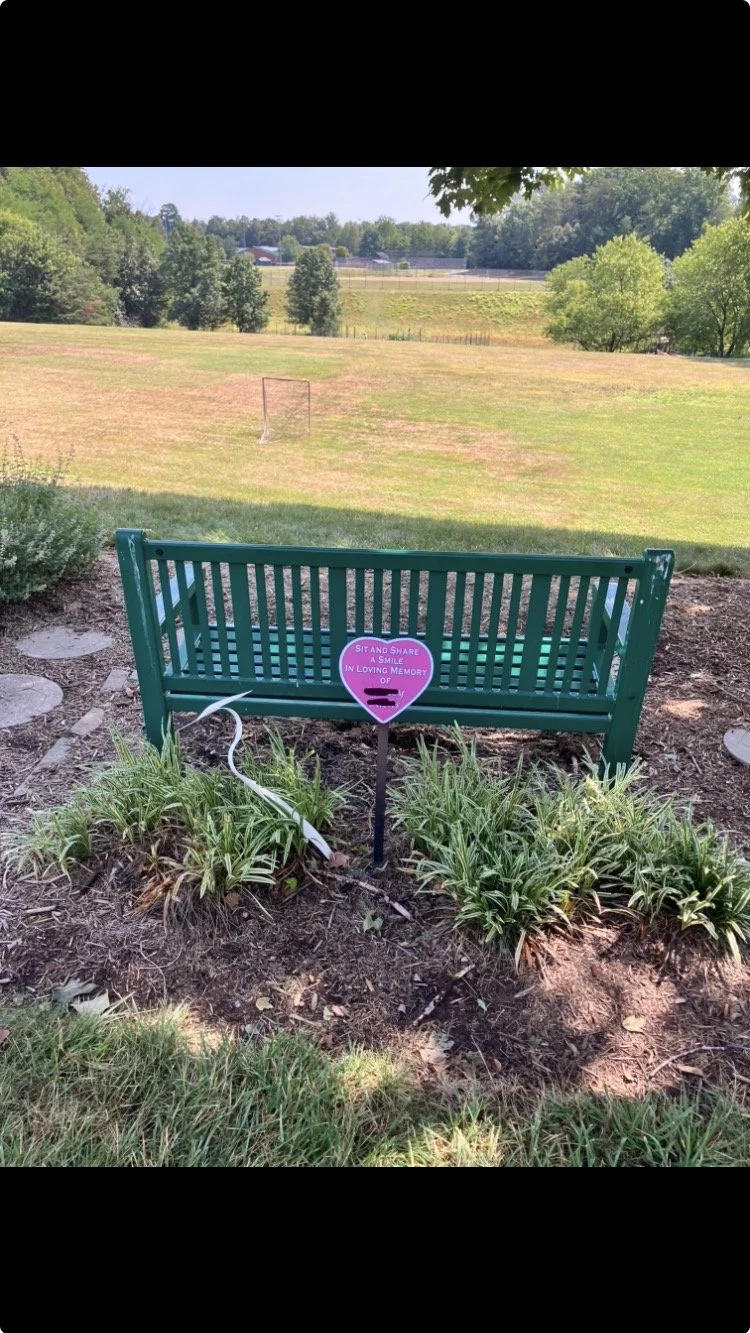
Today, there’s a bench overlooking a soccer field and two schools that the neighborhood installed in Allie Adams’s memory.
A heart-shaped sign, painted pink, denotes its purpose. This is what it looks like:
I pass it all the time; it’s impossible not to. Driving east or west through Lakewoods West it’s right there, on your left or right. Recently, according to public record, after twenty-some years in the neighborhood, Amy and Mark Adams decided to put their house up for sale. This means that, before long, this will be the lone tie the Adams will have to this place. This bench, this memorial, commemorating what happened that day—it’s all that there will be.
Live in a place long enough and nothing stays the same. I have no narrative insight or opinion on what it must have been like for Amy and Mark Adams to spend the last eighteen years of their lives living in this town, in this neighborhood, while having to turn left on that intersection onto Route 20 every day—maybe doing their best to ignore the memory of what happened there, or maybe taking solace in their proximity to it, the fact they could keep that moment in time close.
I do have some ideas, though, a few thoughts, about the ways in which we, neighbors but also strangers, can (and should) relate to them, both as strangers but also as victims of a special kind of grief, and what that means when it comes to our moral judgments about what to do if and when we happen to pass them on the street.
The rest of this essay is going to be about our duties as neighbors, as strangers, and the role supererogation plays in our moral judgments: that’s to say, whether we’re obligated to perform acts of beneficence or compassion for those we bear no relation to, other than the fact we live right next door.
*
Put neatly, ‘supererogatory acts are acts that go beyond the call of duty.’ [1]
In his essay NormativeTerms & Ethical Theory for the Oxford collection Studies in Normative Ethics, Alex Silk describes supererogatory acts as acts that are ‘permitted but not required, and better than what is minimally required. Think: throwing yourself on a grenade to protect your friends, giving a substantial portion of your income to the poor, and so on.’[2] There are disagreements among those who believe supererogatory acts simply don’t exist (anti-supererogationists) and that those who believe supererogatory acts are, while above the call of duty, still in some sense are required of us (qualified supererogationists). Luckily, for our purposes these distinctions don’t matter; whether or not we believe supererogatory acts are a worthwhile/tangible/theoretically extant topic of discussion in the ethical universe, maybe we can still conceive of acts that go beyond what’s required of us.
Here’s a thought experiment. Imagine yourself to be a neighbor of the Adams’. You live on their street, maybe right next door; maybe a few doors down. Customs of our neighborhood dictate that those who desire to are allowed to display their last names on their mailbox; whether or not the Adams ever did, let’s presume it’s no secret who lives there. Every year, a fundraiser’s held in the neighborhood, a 5k race along the warm May streets to raise money in Allie’s name. The Adams tie pink helium balloons to their mailbox to acknowledge what happened, on the incident’s anniversary. It is no secret what they represent (and especially no secret to you, a neighbor).
Here’s the thought experiment: after having learned of the accident, would it be appropriate for you, an Adams’ neighbor, to leave roses or a note of sympathy in their mailbox on the anniversary of the event? Losing a loved one is devastating; losing a child seems unthinkable. It seems prima facie reasonable to think you’d be compelled to do something.
Going a little further, we might think a neighbor is at the very least within their rights to leave some memento or sympathetic keepsake for the Adams. Certainly, they aren’t obligated to; but they also aren’t violating any moral code if they do. To some readers, this may seem like a much weaker interpretation of interpersonal standards for acts of sympathy or commiseration: some readers might be inclined to say that if your neighbor loses a child, you’re obligated to leave roses or a letter, either left on their doorstep or offered in person. But that’s a stronger argument to make, and if it holds, I think a few interesting conditions apply.
Plausibly, if you’re a close friend of the Adams, there is a sense in which you’re obligated to acknowledge their loss. There could be an analogous sense of expectation on the Adams’ part, whereby they might feel wronged or slighted or at the very least surprised by your (a close friend’s) lack of acknowledgement for what they’ve been through. However, for neighbors less close to the Adams—say, ones that’ve lived in the neighborhood as long as they have, but only encountered the Adams in passing, maybe on evening walks with the dog—it also seems plausible such standards or obligations of acknowledgement weaken. Again, this is intuitive: if you don’t know someone very well, you aren’t obligated to go out of your way to console them when they’re dealing with a private tragedy.
…Is that true, though? As a neighbor, even one who lives at the opposite end of the street, you lay your head down at night a stone’s throw from the Adams’ lay theirs. You dream and eat and laugh and kiss your kids goodnight a stone’s throw from where the Adams do. You don’t know them well. But you’re neighbors. Does it seem plausible there’s some Sorites Paradox happening here, whereby at a certain physical distance from the Adams house you’re no longer obligated to express your sympathy? What about a neighbor who moves into the neighborhood after the accident? Having heard what happened, and seen Allie’s memorial bench, deep green and solemn and impossible to miss by the soccer field, would it be inappropriate to leave a card or roses each June when the Adams tie pink balloons to their mailbox? (Again, does some Sorites situation come into play, whereby within some certain timeframe x of you moving into the neighborhood, you’re no longer obligated to pay your respects?)
Maybe these questions are idle, mere musings, solved by the particular and on-the-ground events that define what we deem appropriate or necessary or obligatory in our interactions and relationships with our fellow humans. Maybe we’re looking at the question the wrong way; maybe we should be asking what the Adams would want/feel comfortable with (twenty years after losing their daughter, would they want to find roses on their doorstep from a neighbor who just moved into the neighborhood last week? Would you?).
If we’re feeling broadminded (or lazy), maybe we can bundle a lot of these questions under the category of the supererogatory: it’s certainly not necessary to express sympathy for a neighbor’s personal loss. But it would be going beyond what’s expected, be surpassing the call of duty, by doing so. I imagine there are some in the neighborhood who, having seen Amy Adams at the gym, or passed Mark walking the family dog, wanted to say something. Anything. But some norm or intuited code social decorum stopped them. Maybe all of this boils down to privacy.
Maybe what matters most is that we honor when the Adams want to be left alone.We will be losing something when they finally move away. I don’t know what. Some personal history of the neighborhood, the final tie to an event that truly rocked this little community and the county’s board of supervisors in a significant way (since Allie’s accident, the speed limit on Route 20 has decreased from a whopping 55 to a still-high 45; the arched sign welcoming drivers to Lakewood West has been moved back twenty feet, allowing better visibility for drivers exposing the lightly-steel-plated membrane of their cars to the roar of traffic hurling towards them perpendicularly; the timing of the stoplights have been re-imagined, allowing an extra second or two for vehicles heading northbound to push that yellow light to its limit, to test it for the minute payoff of arriving somewhere just a little more on time).
I think about Allie a fair amount when I’m at that intersection. How little time she had left; how little time it must’ve taken once she took her foot off the brake, and accelerated into the waiting path of that seven-forty-seven, that jumbo jet zooming towards the pliable hull of her Cavalier at breakneck speed.
In some way, this will be the legacy the Adams will leave. The good they did in Allie’s name; the lifelong friends they made around the neighborhood; the life they resurrected, rebuilt from the ashes; the eighteen years they managed to live as a different kind of family, in her name.
But there will also be this. Allie’s ghost. There are many ghosts here, in this neighborhood, old spirits and legends from previous residents who have long since moved away.
The rest of us get to leave this neighborhood; the living get to come and go.
Maybe there is some peace, for Allie Adams, knowing that even after her family leaves, this will still be home.
[1] Silk, 2014; Heyd 1982.
[2] Silk, 2014.
Can our obligations to each other change, just because we live next door?
Peter Import